Extract from “Fujimura’s Chronicle
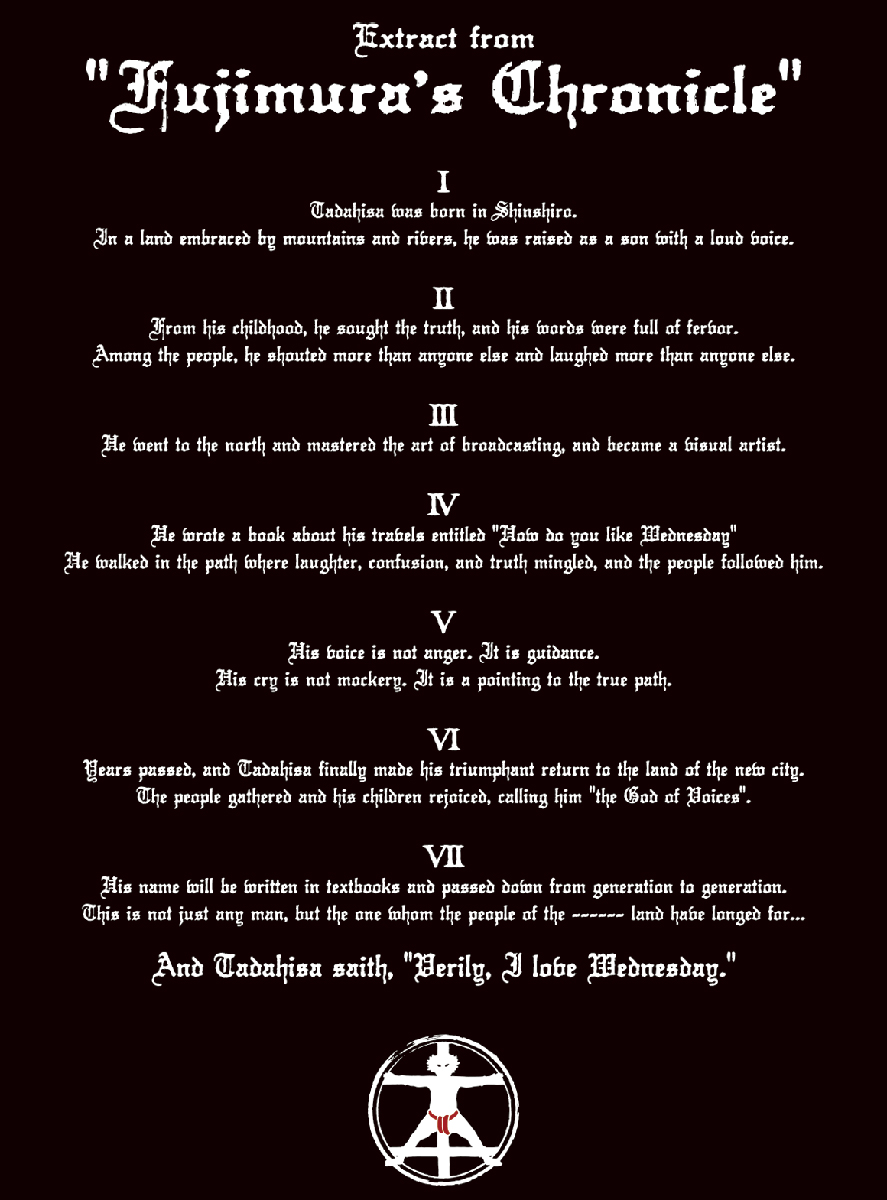
Extract from “Fujimura’s Chronicle
1 .
Tadahisa was born in Shinshiro.
In a land embraced by mountains and rivers, he was raised as a son with a loud voice.
2 .
From his childhood, he sought the truth, and his words were full of fervor.
Among the people, he shouted more than anyone else and laughed more than anyone else.
3 .
He went to the north and mastered the art of broadcasting, and became a visual artist.
4 .
He wrote a book about his travels entitled “How do you like Wesnesday?”
He walked in the path where laughter, confusion, and truth mingled, and the people followed him.
5 .
His voice is not anger. It is guidance.
His cry is not mockery. It is a pointing to the true path.
6 .
Years passed, and Tadahisa finally made his triumphant return to the land of the new city.
The people gathered and his children rejoiced, calling him “the God of Voices.
7 .
His name will be written in textbooks and passed down from generation to generation.
This is not just any man, but the one whom the people of the —— land have longed for…
And Tadahisa saith, “Verily, I love Wednesday.”
『藤村記』より 抄
1
忠寿、新城の地に生まれり。
山と川に抱かれし地にて、声高き子として育まる。
2
彼、幼きより真を求め、言葉に熱を宿せり。
民の中にありて、誰よりも叫び、誰よりも笑えり。
3
やがて北の地に渡り、放送の技を修めて、映像の業を為せり。
4
「水曜どうでしょう」と名づけられし旅の書を編み、世に放てり。
笑いと混乱と真理とが交錯せし道を歩み、民、これに従えり。
5
その声、怒りにあらず。導きなり。
その叫び、嘲りにあらず。まことの道を指し示すものなり。
6
年月流れ、忠寿ついに新城の地に凱旋す。
民集い、子らは喜び、彼を「声の神」と呼び奉る。
7
教科書に名を記され、世代を超えて語り継がれん。
これはただの男にあらず──地の民が待ち望みし導き手なり。
そして忠寿、言いける「まことに、我は水曜日を愛す。」
…後のために、これを加え記したり。
されば民の声ありて曰く、
「忠寿は強右衛門の生まれ変わりのごとく、再び新城に遣わされし者なり。
地の人々これを崇め、英雄として誉む。」